 Skip to content
Hardwood Floor Repair in Bergen County, NJ
Water damage, deep scratches, loose boards, pet damage or worn areas don’t always mean the entire floor needs to be replaced.
Precision Hardwood Flooring provides professional hardwood floor repair throughout Bergen County, NJ. We evaluate the damaged area first, determine how far the problem extends and look for the most practical way to repair the floor while preserving as much of the existing hardwood as possible.
Depending on the condition of the floor, repairs may involve replacing individual boards, correcting loose or damaged sections, addressing localized water damage or preparing repaired areas for sanding and refinishing.
Not sure whether your floor can be repaired? We can inspect the damage and explain what makes sense before you commit to replacing it.
(845)369-8814
Our Floor Repair Process
ASSESSMENT
We begin by looking closely at the damaged area and the surrounding flooring. Scratches, stains, movement, squeaks and water damage can have very different causes, so the first step is understanding what actually needs to be repaired. We also look at the condition of nearby boards and the existing finish so we can determine how the repair may blend with the rest of the floor.
REPAIR
The repair method depends on the type and extent of damage. Some problems can be corrected locally, while severely damaged boards may need to be removed and replaced. When replacement boards are necessary, we work to match the existing wood as closely as practical in species, dimensions and appearance. Additional sanding, staining or refinishing may be recommended when necessary to create a more consistent result.
INSPECTION
Once the repair is complete, we inspect the area for stability, alignment and appearance and make sure the surrounding space is left clean. We’ll also explain anything you should know about the repaired area, including drying or curing time when stain or finish has been applied.
Hardwood Floor Repair FAQs
How can I tell if my hardwood floor needs repair?
A floor usually needs repair when the problem goes beyond normal surface wear. Loose or moving boards, deep gouges, dark water stains, cupping or warping, damaged edges, localized squeaks, broken boards or weakened sections are common signs. If the issue is mainly scratches or a worn finish, refinishing may be the better solution.
Can all hardwood floor damage be repaired?
No. Many localized problems can be repaired, but severe water damage, rot, structural movement or widespread damage may require a larger section of flooring to be removed and replaced. Surface scratches may be handled during refinishing, while individual damaged boards can often be replaced. We evaluate the cause and extent before recommending the repair.
How long does hardwood floor repair take?
Small localized repairs can sometimes be completed relatively quickly, while projects involving multiple board replacements, water damage, sanding, staining or refinishing take longer. The timeline also depends on matching-material availability and whether the repaired area needs finishing work. We give a realistic timeframe after evaluating the floor.
Will the repaired area match my existing floor?
We can usually get close, but an exact match cannot be guaranteed. Existing hardwood changes color with age, sunlight, previous finishes and wear, so new boards may initially look different even when the species and stain are similar. In some cases, sanding and refinishing a larger surrounding area creates a more consistent result.
Can water-damaged hardwood floors be repaired?
Sometimes. Localized water damage may be repairable if the surrounding wood and subfloor remain structurally sound. More severe exposure can cause swelling, cupping, staining, mold concerns or damage beneath the finished floor and may require replacement of the affected section. The moisture source should be corrected before new wood is installed. Cupping alone does not establish the right repair: the floor and underlying conditions need evaluation. Sanding a floor while moisture conditions remain unresolved can leave an uneven result as the boards change.
Repair the Damage Without Replacing More Floor Than Necessary
One of the biggest questions homeowners have after discovering floor damage is whether the entire floor has to come out.
Often, it doesn’t.
When damage is localized, replacing individual boards or repairing a specific section may preserve most of the original floor and reduce unnecessary work.
The challenge is knowing where the damage stops, what caused it and how the repaired area will interact with the surrounding hardwood.
That’s why we evaluate the floor before recommending a solution. When a localized repair makes sense, we’ll tell you. When the damage is too widespread for a small repair to be practical, we’ll explain that too.

Some Of The Towns We Are Proudly Serving
See What Local Homeowners Are Saying
EXCELLENT Based on 121 reviews
 Posted on Google
 Jonathan KurtzmanThis review is about 4 months after the work. I find waiting more helpful because I’ve lived with the floors. Which are great. We bought a place with carpeted bedrooms and existing engineered floors. The existing floors can’t be matched. Russell showed us hardwood, engineered and vinyl to replace the carpets, and we agreed on engineered because it matched better. He suggested installing it lengthwise in the room because then it wouldn’t look like we were trying to match the flooring exactly when we couldn’t. And he suggested gluing it, which really stands out as better in comparison to the existing floating floor. Installation was perfect, as shown by a complete lack of complaints after 4 months. The pricing was good, the work done quickly and completely. No complaints, only a positive recommendation. As a note, we were referred to Russell by our daughter, who is similarly pleased with the work done in her house over a year ago. So a double recommendation!Posted on Google
 Joan KaplanWe had our kitchen and hall floors refinished. Very professional, on schedule and timely completion of job and really nice personnel. I wouldn’t hesitate to recommend this company.Posted on Google
 Steve TPrecision Hardwood Floor were fast efficient and their work is awesome! The floors have a brand new look and feel. We are so glad that we choose them!!!Posted on Google
 Lisa Di LallaThe guys at Precision Hardwood Flooring did an excellent job on my oak floor. It looks brand newPosted on Google
 Anthony NicholasPrecision Flooring exceeded our expectations! This is the second time we’ve chosen them to install and finish new wood floors in our home, and they did not disappoint. The floors look stunning! Russ and his team are honest, professional, and genuinely trustworthy. Highly recommend!Posted on Google
 Keith BraunfotelRuss always does great work. I've used him in my home and office! Always great work!Posted on Google
 Margaret TkachThese guys were great!! My floors are beyond gorgeous! ❤️ Thank you!Posted on Google
 Denny HerzbergVery impressive, the installation went flawless, whole procedure went smooth and the porcelain tiles are installed to perfection. Very grateful to the professionalism of Christian and Hugo, both were superb and thanks to Russel who kept us informed as needed. Thank you, we are very happy with our new kitchen floor. Denny Herzberg, 518 Gair Street, Piermont, N.Y. 10968Posted on Google
 Scott SPrecision Hardwood refinished 4 bedroom floors. They did a good job matching the existing hallway floor and they look great. Quick and efficient.Posted on Google
 Hal RifkinOutstanding job-thorough and professional. Residents of PiermontVerified by TrustindexTrustindex verified badge is the Universal Symbol of Trust. Only the greatest companies can get the verified badge who has a review score above 4.5, based on customer reviews over the past 12 months. Read more

Common Floor Problems We Repair
Water Damage
Leaks, appliances, plumbing problems and repeated moisture exposure can stain, swell or distort hardwood boards.
Pet Damage
Deep scratches, stains and repeated moisture exposure from pets can sometimes require more than surface refinishing.
Deep Scratches & Gouges
When damage extends through the finish and into the wood, sanding or localized board repair may be necessary.
Loose or Squeaky Boards
Movement can sometimes come from the flooring itself, the fastening method or conditions underneath the floor.
Damaged Individual Boards
A broken or severely damaged board doesn’t always mean replacing the entire room. Individual boards can often be removed and replaced.
Older Repairs That Don’t Match
Previous repairs may use a different wood, stain or board size. Depending on the condition, we may be able to improve how the repaired section blends with the surrounding floor.
Real Hardwood Floor Repair Work
These examples come from Precision Hardwood Flooring repair work and show two different situations: localized water damage and board replacement that needs to blend into an existing floor.
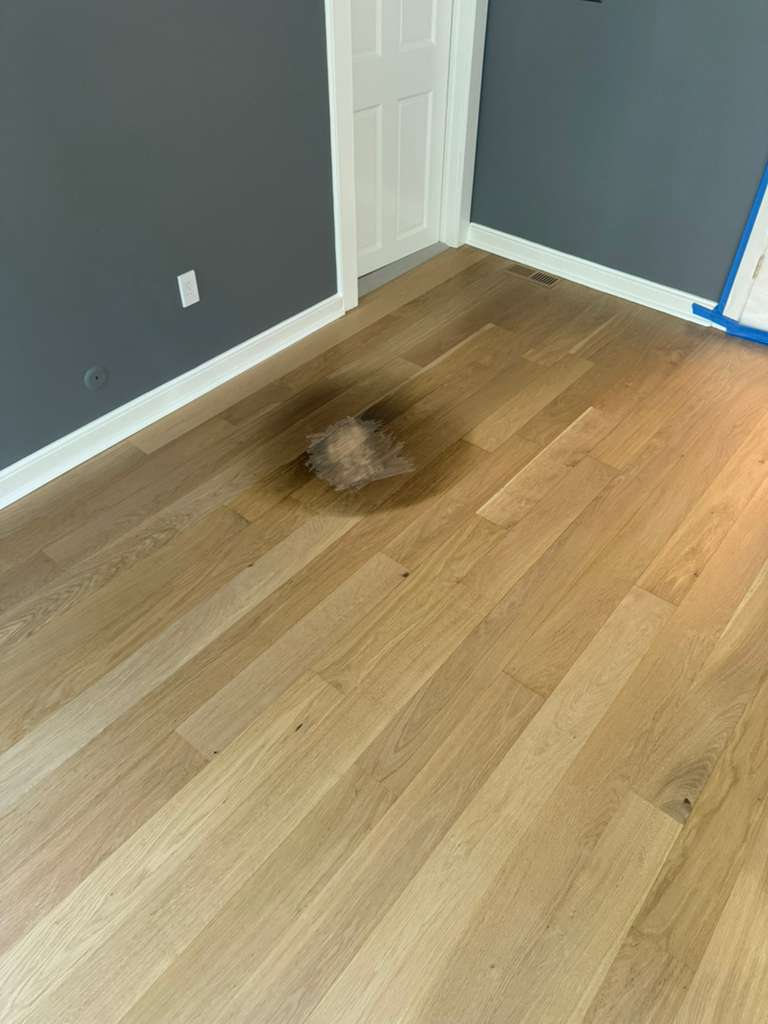
Water-Damaged Hardwood Repair
This Precision project documents deep water staining on wide-plank oak. The damaged area was treated as a repair and restoration problem rather than assuming the entire floor needed replacement.
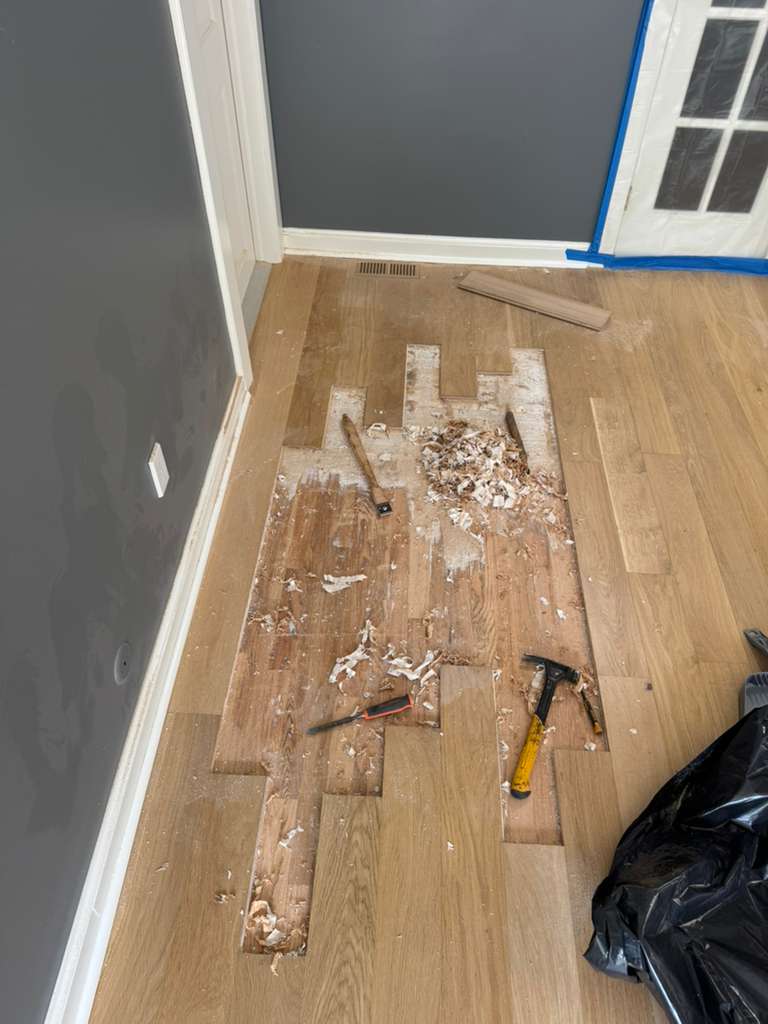
Board Lacing & Repair
For this repair, boards were removed in a staggered pattern so replacement wood could be laced into the existing floor instead of creating a straight patch line. This approach helps the repaired section integrate more naturally with the original flooring.
